




About the Shakti Liquid Culture
The Shakti liquid culture is described as a true albino selection associated with the Malabar Coast Psilocybe cubensis lineage. Unlike leucistic varieties, which retain some degree of pigmentation, Shakti is characterised by a strongly depigmented appearance, giving its fruiting bodies a distinctive white to creamy-white look.
Cloud920 places Shakti within its Hybrid Fusion Series, which includes modern selections developed through deliberate genetic and phenotype work. The lineage is attributed to MycoMama Angela, who selected and stabilised the albino expression from Malabar Coast material associated with 3M.
This distinctive phenotype makes Shakti a particularly interesting addition to the Cloud920 cubensis liquid culture range.
The Selection Behind Shakti
The Malabar Coast lineage takes its name from the southwestern Indian coastal region, particularly areas associated with Kerala and Karnataka. Psilocybe cubensis has historically been reported from cattle-grazing environments in tropical regions, while the Malabar lineage became widely circulated among mushroom enthusiasts through specialist spore vendors.
Shakti is understood to have emerged from an unusual albino expression found within Malabar-related material. MycoMama Angela subsequently selected and stabilised this phenotype, establishing a lineage distinguished from the conventional pigmented Malabar form.
The name Shakti, associated with divine feminine energy in Hindu philosophy, complements the lineage’s connection with the Indian subcontinent.
Cloud920’s Hybrid Fusion classification reflects this deliberate breeder-led selection rather than treating Shakti as an untouched wild collection or conventional Heritage lineage.
Visual Characteristics of Shakti
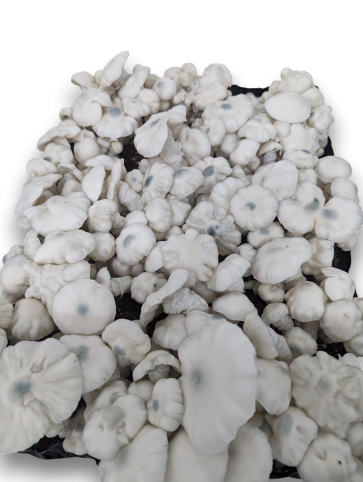
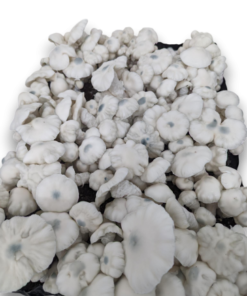
Shakti’s most obvious characteristic is its very pale pigmentation. The fruiting bodies are generally described as ghostly white through to creamy white, creating a noticeably different appearance from standard golden, brown or caramel-coloured cubensis varieties.
Caps can develop rounded, irregular or wavy forms, with veils sometimes remaining visible for longer than expected. This unusual combination can make Shakti particularly interesting for microscopy.
The stems are typically white, substantial and relatively stout. Pronounced blue bruising may become visible following handling.
Interestingly, Shakti is reported to produce dark purple-brown spore prints despite its strongly albino appearance. This provides an important distinction between its external pigmentation and its reproductive characteristics.
The combination of pale fruiting bodies, unusual cap structure, persistent veils and dark spore pigmentation gives Shakti a distinctive microscopic profile.
General Characteristics of the Hybrid Fusion Culture
Community descriptions generally characterise Shakti as a vigorous lineage associated with the robust growth characteristics of its Malabar background.
Reports concerning development speed and productivity can vary between individual cultures, substrates and environmental conditions. These observations should therefore be considered community-based rather than guaranteed product characteristics.
For researchers comparing modern Cloud920 genetics, Shakti provides an interesting example of how a naturally occurring phenotype can subsequently be preserved and refined through deliberate selection.
For another Hybrid Fusion culture with a contrasting appearance, see the Coffee Cream liquid culture.
Shakti Potency Profile
There is currently no verified independent laboratory dataset providing a definitive potency measurement for Shakti.
Some community and vendor descriptions characterise the lineage as potentially above average for P. cubensis, although these claims have not been sufficiently supported by published laboratory testing.
For that reason, no specific potency figure should be interpreted as a guaranteed characteristic of this culture. Alkaloid concentrations can vary considerably between individual specimens, batches and samples, and laboratory analysis is required to establish an actual chemical profile.
What You Receive in Your Cloud920 Syringe
The Cloud920 Shakti liquid culture is supplied as one 10 cc syringe containing Shakti mycelium suspended in Cloud920’s nutrient medium.
A sterile needle is supplied with the syringe. Cloud920 states that its production batches undergo quality-control checks covering characteristics such as viability, sterility and mycelial morphology, including verification of the expected albino phenotype.
The product forms part of Cloud920’s Hybrid Fusion Series.
Storage and Handling
Store the syringe according to the manufacturer’s instructions and the information provided on the product label.
Keep it upright and protected from direct light, excessive heat and freezing temperatures. For legitimate microscopy and laboratory research, appropriate sterile handling and good laboratory hygiene should be maintained.
Microscopy and Mycological Research Only
The Shakti liquid culture is supplied for microscopy and mycological research purposes only.
The legal position concerning Psilocybe species and psilocybin-producing fungi varies throughout Europe and other jurisdictions. Possession, cultivation and distribution may be restricted or prohibited depending on local law.
Always check the regulations applicable in your country before purchasing, possessing or using this type of research material.
Frequently Asked Questions
What makes Shakti a Hybrid Fusion strain?
Shakti is described as a deliberately selected and stabilised albino phenotype originating from Malabar Coast-related P. cubensis genetics. The breeder-led selection process distinguishes it from an unmodified wild population or a long-established Heritage strain.
This is why Cloud920 places Shakti within its Hybrid Fusion Series.
Is Shakti genuinely albino?
Shakti is described as a true albino selection, rather than simply a leucistic variety. Its characteristic appearance is associated with extensive loss of visible pigmentation. Its dark purple-brown spore prints are nevertheless an important feature and demonstrate why external pigmentation alone should not be used to classify every pale cubensis phenotype.
What makes Shakti visually distinctive?
The combination of almost entirely white fruiting bodies, substantial stems, irregular or wavy caps and occasional persistent veils gives Shakti a recognisable appearance under microscopy.
How is liquid culture different from a spore syringe?
A spore syringe contains fungal spores, whereas liquid culture contains established mycelium suspended in a liquid medium. They therefore represent different types of research material and have different applications in microscopy and mycological work.
How should I store the Cloud920 Shakti syringe?
Follow the storage information supplied with the product. Keep the syringe upright, protected from direct light and extreme temperatures, and use it within the stated shelf life.
Why does the product state “for microscopy and mycological research”?
Regulations covering psilocybin-producing fungi differ significantly between European countries and other jurisdictions. Some locations restrict or prohibit possession, cultivation or distribution. The Shakti culture is therefore supplied for microscopy and mycological research purposes only. Verify the legislation applicable in your location before use.
Is the Cloud920 Shakti culture laboratory verified?
Cloud920 states that its cultures are produced under controlled laboratory conditions and undergo quality-control checks relating to viability, sterility and morphology before the syringe is sealed and supplied.
Be the first to review “Shakti Liquid Culture – Cloud920”
Related products

Liquid Culture Syringes

Liquid Culture Syringes

Liquid Culture Syringes

Liquid Culture Syringes

Liquid Culture Syringes

Liquid Culture Syringes

Liquid Culture Syringes

Liquid Culture Syringes
Reviews
There are no reviews yet.