
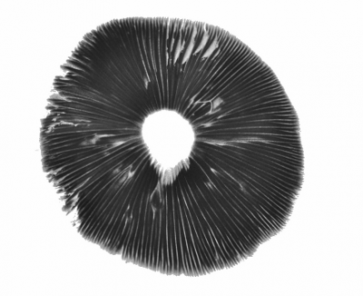
Hawaii – Panaeolus cyanescens spore print
€22,00
The Hawaii is a Panaeolus cyanescens — an entirely different species from Psilocybe cubensis and widely regarded as one of the most potent psilocybin-containing mushrooms in the world.
Its slender, elegant fruiting bodies with pale grey caps and jet-black spores originated in the tropical grasslands of the Hawaiian Islands.
Collectors and researchers prize the Hawaiian Panaeolus cyanescens for its extraordinary potency, striking blue bruising reaction and its unique place outside the cubensis family.
Hawaii — A Distinctive Panaeolus cyanescens Lineage
The Hawaii variety is an important exception in a collection dominated by Psilocybe cubensis. Rather than belonging to the cubensis species, it is associated with Panaeolus cyanescens, also known as Copelandia cyanescens.
The species is recognised for its delicate tropical morphology, dark spores and distinctive blue bruising. Because it belongs to a different genus, Hawaii offers collectors an opportunity to explore characteristics that differ considerably from those typically encountered in P. cubensis specimens.
A Tropical Species with a Long History
Panaeolus cyanescens was formally described in the nineteenth century by British mycologists Miles Joseph Berkeley and Broome, based on material collected in Sri Lanka. The species is associated with tropical and subtropical environments and has subsequently been recorded across numerous warm regions worldwide.
Hawaii became particularly associated with the species because its warm, humid climate and cattle-rich environments provide suitable ecological conditions. This association eventually gave rise to the familiar “Hawaiian” name used within mushroom-collecting communities.
Today, Panaeolus cyanescens is known from tropical and subtropical areas across several continents, while Hawaiian material remains especially recognisable among collectors.
Why Hawaii Is Not a Cubensis
The distinction between Panaeolus cyanescens and Psilocybe cubensis is significant from a taxonomic and morphological perspective. The two belong to different genera and display several obvious differences:
- Taxonomy: Hawaii belongs to the genus Panaeolus, rather than Psilocybe.
- Spore colour: Panaeolus cyanescens produces characteristically black spores, contrasting strongly with the purple-brown spores typical of P. cubensis.
- Morphology: The fruit bodies are generally much more delicate, with narrow stems and comparatively small caps.
- Ecology: The species is strongly associated with warm, tropical and subtropical environments.
- Microscopy: Its black spore deposits and distinctive microscopic characteristics make it an interesting comparison with cubensis material.
These differences make Hawaii an especially useful addition for collectors who want to broaden their library beyond Psilocybe cubensis.
Typical Hawaii Morphology
Panaeolus cyanescens has an appearance that is noticeably different from the familiar cubensis form:
- Cap: Small and delicate, generally hemispherical to convex. Colour can range from light brown in younger specimens to pale grey, cream or whitish tones as the cap matures.
- Stem: Long, narrow and fragile compared with the considerably thicker stems of many cubensis varieties.
- Gills: Initially lighter in colour before developing darker, mottled areas as the spores mature.
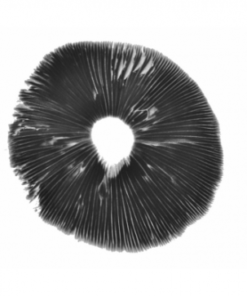
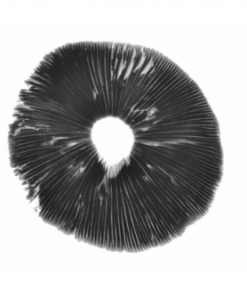
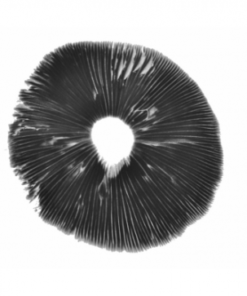
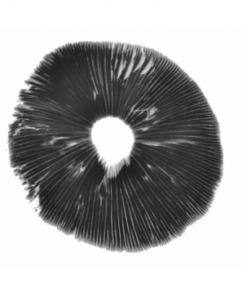
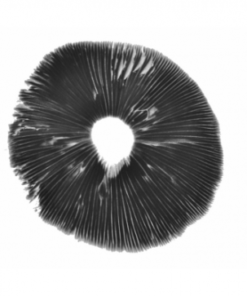
- Spore print: Deep jet black — one of the easiest visual characteristics for distinguishing Panaeolus material from typical cubensis prints.
- Bruising: Damaged tissue can develop a pronounced blue to blue-green colouration.
An Intriguing Addition for Comparative Microscopy
For microscopy enthusiasts, Hawaii provides an opportunity to examine a species outside the usual P. cubensis collection. Its slender morphology, dark spore deposits and distinctive microscopic characteristics offer useful points of comparison when studying different mushroom genera.
It is worth remembering that naturally occurring specimens can vary considerably. Size, pigmentation and other visible traits may change according to genetics, maturity and environmental conditions.
How to Use a Spore Print
If you are new to working with mushroom spore prints, our dedicated guide covers the fundamentals of handling, preparing and storing prints for microscopy and collection purposes.
Why Add Hawaii to Your Collection?
If your spore library currently focuses mainly on Psilocybe cubensis, Hawaii (Panaeolus cyanescens) provides a clear opportunity to introduce greater taxonomic and morphological diversity.
Its tropical background, slender fruit-body structure, striking black spore prints and association with Hawaiian populations give it a distinctive identity within a broader mushroom collection. For enthusiasts interested in comparative microscopy and fungal diversity, it represents a particularly interesting specimen outside the traditional cubensis catalogue.
Be the first to review “Hawaii – Panaeolus cyanescens spore print”
Related products
Spore Prints
Spore Prints
Spore Prints
Spore Prints
Spore Prints
Spore Prints
Spore Prints
Spore Prints
Reviews
There are no reviews yet.